
News
“The Financial Sector Must Be an Active Driver of the Climate Transition,” Says MMA Governor
The Maldives’ financial sector must move beyond a passive role and actively drive the country’s climate and development agenda, Maldives Monetary Authority (MMA) Governor Ahmed Munawar said on Thur...
Mohamed Hilmy
22 December 2025, 00:00
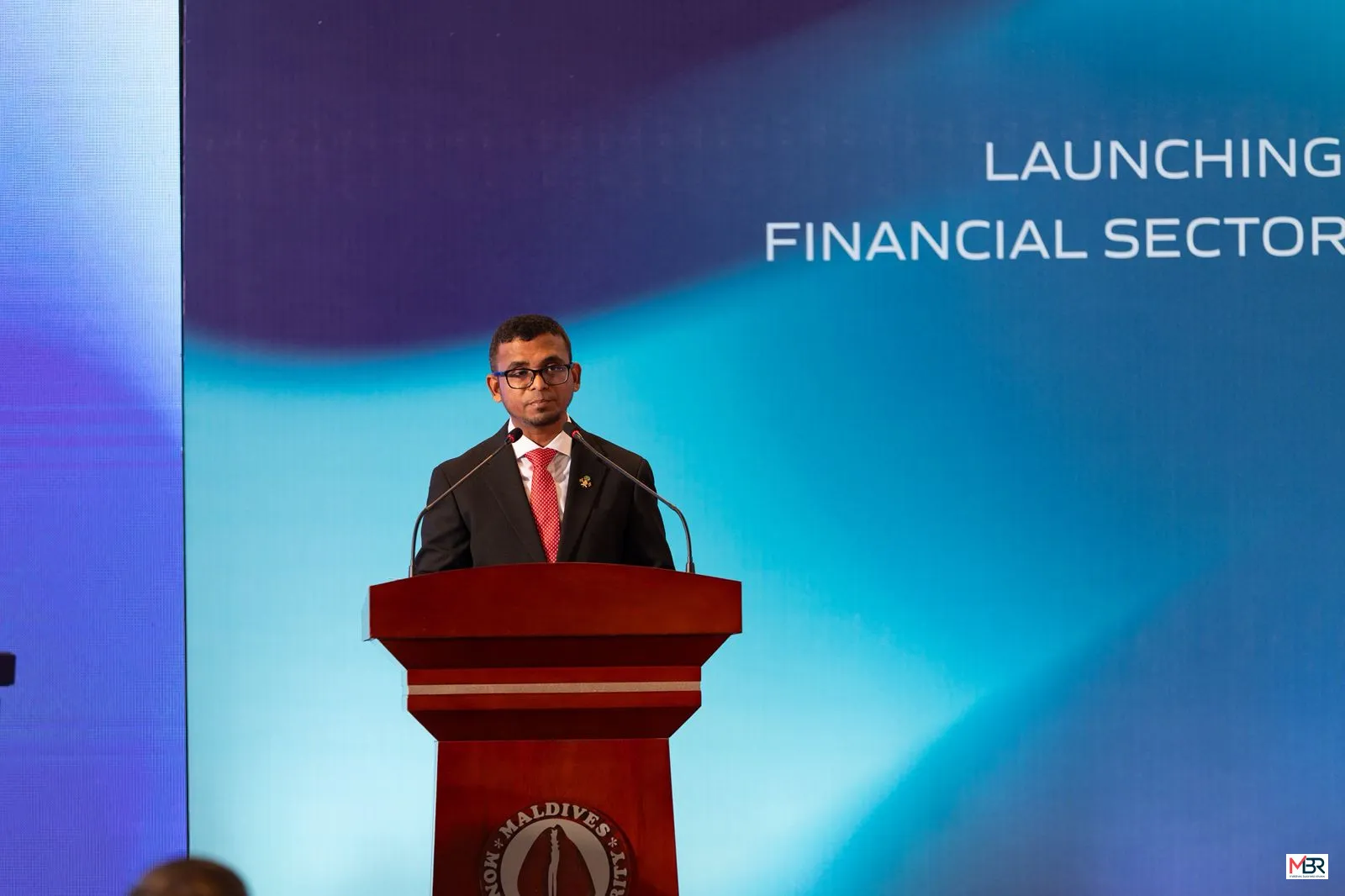
The Maldives’ financial sector must move beyond a passive role and actively drive the country’s climate and development agenda, Maldives Monetary Authority (MMA) Governor Ahmed Munawar said on Thursday, as the central bank rolled out a trio of reforms aimed at reshaping finance as a catalyst for inclusive, digital, and sustainable growth.
Speaking at a
high-level ceremony inaugurating the National Financial Inclusion Strategy,
Payment Maldives, and the National Sustainable Finance Roadmap, Governor Ahmed
Munawar said the initiatives collectively mark a turning point in how the
financial system serves the economy, households, and businesses. The event was
inaugurated by Mohamed Muizzu and attended by senior government officials,
financial institutions, and development partners.
Governor Munawar
outlined an ambitious target to double the financial sector’s contribution to
national GDP from 6 percent to 12 percent within five years, positioning
finance as a driver of economic diversification rather than a supporting
service. He said achieving this goal would require stronger financial
intermediation, modernised infrastructure, and an enabling environment that
promotes innovation while preserving stability.
At the centre of
the reform agenda is the National Financial Inclusion Strategy, developed using
findings from the 2022 National Financial Inclusion Survey. The survey
highlighted persistent gaps, including higher levels of exclusion among women,
limited use of insurance and risk-mitigation products, low adoption of digital
banking among the elderly despite high internet penetration, and continued
reliance on informal borrowing by the self-employed. Rising incidents of
financial scams, particularly targeting older age groups, were also identified
as a growing concern.
The strategy
moves beyond access alone, focusing on strengthening financial capability,
digital confidence, and consumer protection. Particular emphasis is placed on
youth and the elderly to ensure that vulnerable groups are not left behind as
the financial system modernises. The MMA said financial literacy initiatives
have already reached thousands nationwide, with further plans to develop an
annual national financial literacy plan in collaboration with government
agencies and financial institutions.
A major pillar
of the transformation is Payment Maldives Pvt Ltd, a newly established national
payments entity designed to accelerate the shift toward a fully digital
payments ecosystem. Governor Munawar noted a sharp decline in cheque usage over
the past six years alongside a rapid increase in digital transfers, a trend
further accelerated by the introduction of Favara. Transaction volumes and
values processed through Favara have doubled, reflecting strong public demand
for faster and more convenient payment solutions.
Payment Maldives
is envisioned as a collaborative ecosystem bringing together banks, fintechs,
and service providers to deliver instant, secure, and interoperable payments
nationwide. Planned milestones include the rollout of a national QR-code
payment system by April 2026 and the first cross-border integration of Favara
with India’s UPI by July 2026. The MMA has invited all banks and payment
service providers to participate in the venture as equity partners, following
international models adopted in countries such as India, Malaysia, Jordan, and
Türkiye.
Addressing
climate finance, Governor Munawar said the Maldives faces urgent funding needs,
with studies estimating more than USD 800 million required annually for
mitigation alone. He stressed that public financing would be insufficient to
meet these demands, making it essential for the financial sector to actively
support the climate transition. The National Sustainable Finance Roadmap
provides a framework to mobilise capital toward national priorities including
climate adaptation, renewable energy, sustainable housing, green transport, and
the blue economy, while supporting the country’s target of sourcing 33 percent
of electricity from renewables by 2028.
To
operationalise the roadmap, the MMA plans to introduce green, social, and
sustainability-linked lending frameworks, develop enabling legislation for
climate-aligned finance, and establish a national sustainable finance taxonomy
aligned with international standards. The objective, the Governor said, is to
align financial flows with national resilience goals and bridge economic
security with climate security.
Governor Munawar
emphasised that the three initiatives are deeply interconnected, with financial
inclusion expanding access and usage, sustainable finance directing capital
toward priority sectors, and Payment Maldives providing the digital backbone to
support both. He underscored that the transformation cannot be achieved by the
central bank alone, calling for sustained collaboration among financial
institutions, government agencies, and development partners.
With the launch
of the three initiatives, the Maldives Monetary Authority signalled a decisive
shift toward a modern, inclusive, and climate-aligned financial system,
positioning finance as a central pillar of the Maldives’ long-term development
and resilience agenda.
Leave a comment
Comments
No comments yet. Be the first to comment!
Latest News
News
SME Digital Opens MVR 10 Million Gateway to Guesthouse Tourism
11 Feb 2026
News
Maldives Sets Sights on 2027 Tourism Boom, Ministry Launches Branding Drive
11 Feb 2026
News
No Gas Shortage in Maldives, STO Assures Public Amid Supply Fluctuations
11 Feb 2026
News
Maldives Tourism Opens 2026 Strong as Arrivals Top 303,000, Led by China and Russia
11 Feb 2026